


Estimated reading time: 4–5 minutes
How a Roth IRA Can Help Future Generations
Inherited Roth IRA Rules High-Net-Worth Families and Business Owners Should Understand1
For high-net-worth individuals and business owners, retirement planning often becomes legacy planning. Once your own retirement needs are secure, the question may shift to which assets are best spent, preserved, or transferred to future generations.
A Roth IRA can be especially valuable because qualified withdrawals are free from federal income tax and the original owner has no lifetime required minimum distributions. Assets that are not needed for current spending can therefore remain invested and potentially continue growing for heirs.
Why a Roth IRA Can Be a Valuable Legacy Asset
Affluent families often own taxable investments, traditional retirement accounts, business interests, real estate, insurance, and trusts. Each asset has different income-tax, estate-tax, and transfer implications.
A Roth IRA may be attractive to leave to children or grandchildren because qualified distributions generally do not increase the beneficiary’s taxable income. This can be particularly helpful when heirs inherit during their peak earning years. The account cannot remain open indefinitely, however; inherited Roth IRAs are subject to specific distribution deadlines.
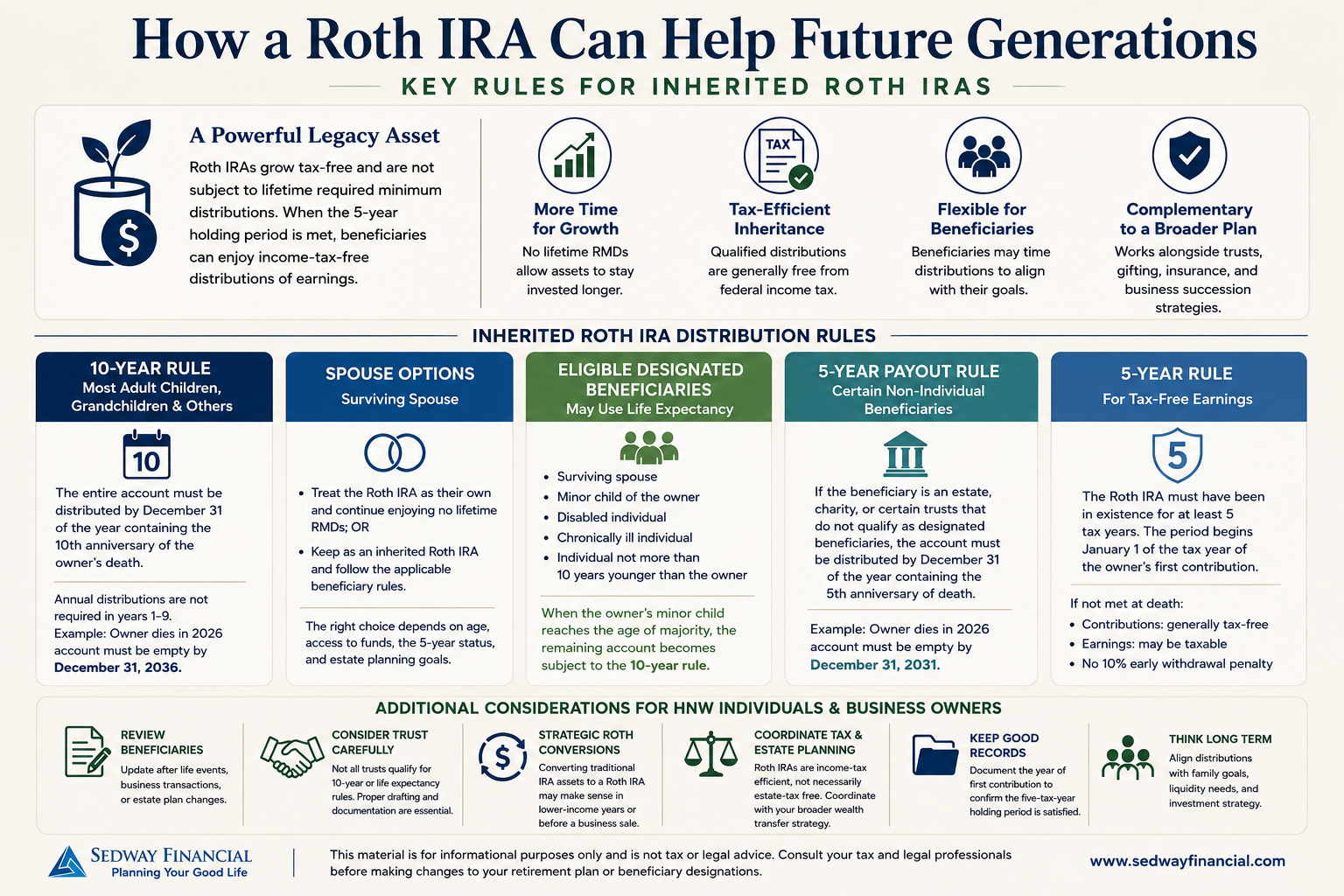
The 10-Year Rule for Most Adult Children and Grandchildren
For Roth IRA owners who die after 2019, most adult children, grandchildren, and other nonspouse individual beneficiaries must fully distribute the account by December 31 of the year containing the tenth anniversary of the owner’s death.
For example, if the owner dies in 2026, the inherited Roth IRA generally must be emptied by December 31, 2036.
Because a Roth IRA owner is treated as having died before the required beginning date, beneficiaries subject to the 10-year rule generally do not have to take annual distributions during years one through nine. They may withdraw gradually or leave the account invested until the final year. The timing should reflect the beneficiary’s goals, liquidity needs, and investment risk.
Two Different Five-Year Rules
1 The Five-Year Rule for Tax-Free Earnings
The five-tax-year holding period begins January 1 of the tax year for which the owner first contributed to any Roth IRA. A beneficiary uses the original owner’s holding period; the inheritance does not start a new five-year clock. If the owner dies before that period is complete, regular contributions are generally tax-free, but earnings withdrawn before the five-year period ends may be taxable. Once the holding period is satisfied, distributions made after death are generally qualified and income-tax-free.
2 The Five-Year Beneficiary Payout Rule
When the beneficiary is not an individual: such as the owner’s estate, a charity, or certain trusts; the Roth IRA may have to be fully distributed by December 31 of the year containing the fifth anniversary of death. For example, if the owner dies in 2026, the account would generally have to be emptied by December 31, 2031.
This rule determines how long the account may remain open; it does not by itself determine whether a distribution is taxable. No distributions are generally required before the final deadline when the five-year payout rule applies.
Be Careful When Naming a Trust
High-net-worth families may use trusts for asset protection, controlled distributions, or younger and vulnerable beneficiaries. However, naming a trust as the Roth IRA beneficiary can change the payout rules.
For the trust’s beneficiaries to receive designated-beneficiary treatment, the trust generally must:
- Be valid under state law
- Be irrevocable or become irrevocable at death
- Have identifiable beneficiaries
- Provide the required documentation to the IRA custodian
A trust that does not qualify may trigger the five-year payout rule. Beneficiary designations and trust documents should therefore be reviewed together. A trust designed for a business interest or taxable investment portfolio may not produce the intended result when named as an IRA beneficiary.
Roth Conversions as Part of a Multiyear Strategy
High-income individuals may be unable to make direct Roth IRA contributions because of income limits, but traditional IRA assets may generally be converted to a Roth IRA regardless of adjusted gross income. The taxable portion is generally included in income for the conversion year.
For business owners, conversion planning may be useful during lower-income years, after retirement, before or after a business sale, or when market values are temporarily lower. The central question is whether paying tax today could reduce the family’s combined tax burden over the owner’s lifetime and the beneficiary’s distribution period.
Because large conversions can increase current taxes and affect other tax calculations, they are often best evaluated through coordinated, multiyear projections.
A Roth IRA Does Not Eliminate Estate-Tax Planning
A Roth IRA’s favorable income-tax treatment does not automatically remove its value from the owner’s gross estate. Families with potential federal or state estate-tax exposure should coordinate Roth planning with trusts, lifetime gifts, charitable strategies, liquidity needs, and the transfer of business or real-estate interests.
The Bottom Line
A Roth IRA can be more than a retirement account. For families who do not expect to spend all their retirement assets, it can provide additional years of potential tax-free growth and an income-tax-efficient inheritance.
The strategy depends on getting the details right: starting the five-year clock, choosing beneficiaries carefully, understanding the five- and 10-year rules, evaluating Roth conversions, and coordinating the account with the broader estate plan.
 New Roth Catch Up Rule for High Earners
If you have questions about how this affects you personally, we welcome the opportunity to speak with you. You may Schedule an Appointment or call 916-833-6100.
1 IRS
This material is intended for general public use. By providing this content, Park Avenue Securities LLC and your financial representative are not undertaking to provide investment advice or make a recommendation for a specific individual or situation, or to otherwise act in a fiduciary capacity. Roth contribution and distribution rules are subject to IRS requirements and may change based on future legislation. Individual results will vary. Examples are hypothetical and for illustrative purposes only. Consult your tax, legal, and financial professionals regarding your specific situation. Guardian, its subsidiaries, agents, and employees do not provide tax, legal, or accounting advice. Consult your tax, legal, or accounting professional regarding your individual situation.