


What the New Roth Catch-Up Rule Means for You1
Starting in 2026, a new IRS rule under the SECURE 2.0 Act will change how some people save for retirement. If you are age 50 or older and earn more than $150,000 per year, your catch-up contributions to workplace retirement plans, such as 401(k), 403(b), and governmental 457 plans, must be made as Roth (after-tax) contributions.
Normally, once you turn 50, the IRS allows you to contribute extra money beyond the standard limit to boost your retirement savings. While you previously could choose to make these catch-up contributions pre-tax to lower your current taxable income, the new rule shifts the tax advantages for higher earners.
How This Affects Your Wallet
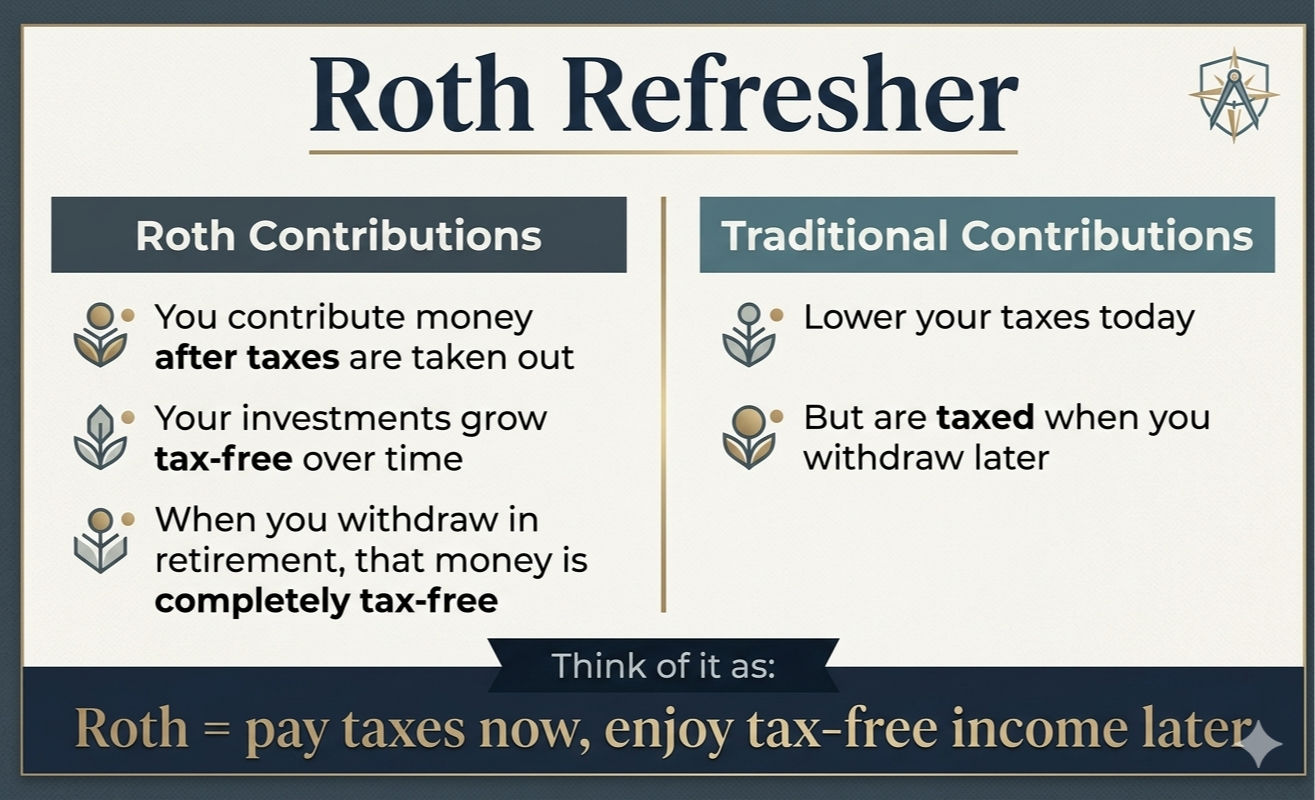
- You May Pay More Taxes Now: Higher earners will no longer get an upfront tax break on catch-up contributions, resulting in a slightly higher current tax bill and lower take-home pay.
- You Get Tax-Free Income Later: In exchange, your catch-up money grows entirely tax-free, and you may not owe any taxes when you withdraw it during retirement. Qualified Roth distributions are generally federal income tax-free if applicable IRS requirements are satisfied
- Not Everyone Is Affected: If you earn $150,000 or less, this rule does not apply to you, and you can continue to choose between pre-tax and Roth contributions. Additionally, this change does not apply to IRAs (Traditional or Roth), so IRA contribution rules remain exactly the same.
Interaction with Standard, Non-Catch-Up Contributions
It is important to understand that this new regulation only applies to your catch-up contributions. It does not force your entire retirement strategy to change.
- Your Standard Contributions Stay Flexible: Even if you make more than $150,000, you retain full control over your standard, base 401(k) contributions (up to the regular IRS limit, which is $24,500 for 2026). You can still choose to make those base contributions 100% pre-tax to successfully lower your current year taxable income.
- How They Separate in Payroll: Your plan administrator or payroll system will track these separately. For instance, you can maximize your tax deduction today by directing your standard $24,500 into a traditional pre-tax account, while only your remaining catch-up portion (up to $8,000, or $11,250 if you are ages 60–63) will automatically route into the Roth bucket.
Real-World Retirement Contribution Strategies (2026 Limits)
To illustrate how these regulations function in practice, here is a direct comparison of three distinct, real-world age and income scenarios based on the IRS 2026 retirement contribution limits:
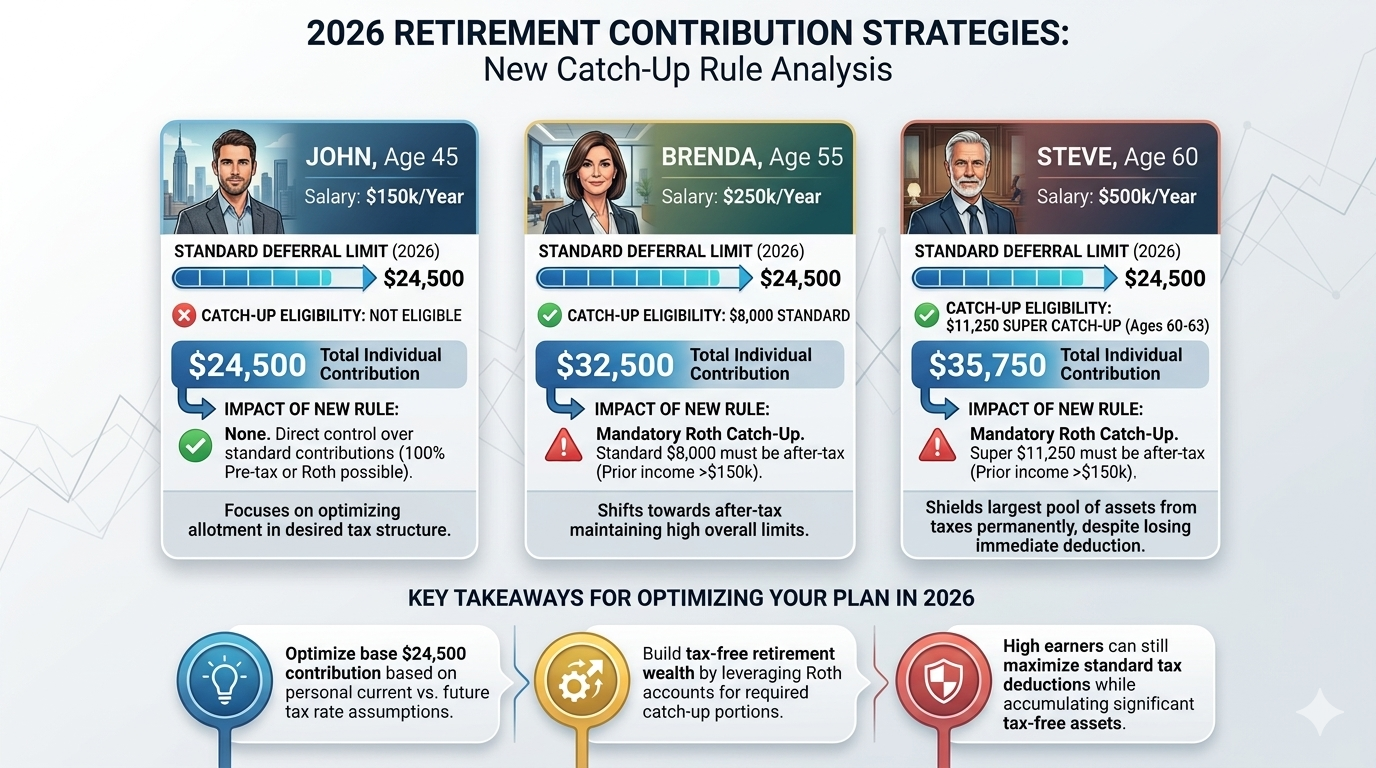
- John has not yet reached the age threshold. His strategy focuses entirely on optimizing his primary $24,500 allotment between traditional pre-tax relief or Roth growth based on his current bracket.
- Brenda must shift her standard $8,000 catch-up amount into after-tax Roth buckets. This eliminates an upfront deduction on that portion but allows her to build tax-free wealth later.
- Steve qualifies for the elevated SECURE 2.0 "Super Catch-Up" of $11,250. Because of his high tax bracket, he loses a significant immediate deduction, but he gains the potential ability to shield a larger pool of compounding assets from taxes permanently.
What You Should Do Next
While this change alters how you save, it does not change why. You are still building toward a secure, flexible, and tax-efficient retirement. You do not need to take immediate action, but it is a great time to:
- Review your current retirement plan contributions.
- Understand the upcoming impact on your net take-home pay.
- Evaluate your long-term future tax strategy.
Beyond tax advantages, Roth accounts may help provide opportunities for future generations.
If you have questions about how this affects you personally, we welcome the opportunity to speak with you. You may Schedule an Appointment or call 916-833-6100.
1 IRS
This material is intended for general public use. By providing this content, Park Avenue Securities LLC and your financial representative are not undertaking to provide investment advice or make a recommendation for a specific individual or situation, or to otherwise act in a fiduciary capacity. Roth contribution and distribution rules are subject to IRS requirements and may change based on future legislation. Individual results will vary. Examples are hypothetical and for illustrative purposes only. Consult your tax, legal, and financial professionals regarding your specific situation. Guardian, its subsidiaries, agents, and employees do not provide tax, legal, or accounting advice. Consult your tax, legal, or accounting professional regarding your individual situation.