


Is Stagflation Coming Back? What “Stagflation Lite” Means for the Economy and Investors in 2026
For much of the past several years, inflation has dominated economic headlines. After surging following the pandemic, prices rose at the fastest pace in decades, prompting the Federal Reserve to raise interest rates aggressively to cool inflation.
While inflation has eased from its peak, a new concern is emerging among economists and market analysts: “stagflation lite.”
This term describes an environment where inflation remains elevated while economic growth slows, creating a challenging backdrop for policymakers, businesses, and investors. Unlike the severe stagflation experienced in the 1970s, this modern version may be milder—but it can still affect financial markets and long-term planning.
Recent developments—including geopolitical tensions involving Iran, rising oil prices, tariffs, persistent inflation, and signs of a cooling labor market—have renewed discussion about stagflation risks in the current economic cycle.
While the U.S. economy is not currently experiencing the severe stagflation seen in the 1970s, a combination of persistent inflation and slowing growth has led economists to increasingly discuss the possibility of a stagflation-like environment in the years ahead.
Key Takeaways
- Stagflation lite refers to an environment where inflation remains elevated while economic growth slows.
- Rising oil prices, tariffs, and geopolitical tensions are contributing to renewed stagflation concerns in 2026.
- Money supply trends (M1 and M2) and a cooling labor market are important indicators economists monitor when evaluating inflation risks.
- The Federal Reserve faces a difficult balance between controlling inflation and supporting economic growth.
- For investors, diversification and long-term planning remain important strategies during uncertain economic environments.
Stagflation Meaning
Stagflation is an economic condition in which inflation remains high while economic growth slows and unemployment rises. The term became widely known during the 1970s oil crisis, when energy price shocks caused inflation to surge while economic activity weakened.
Today, economists sometimes use the phrase “stagflation lite” to describe a milder version of this environment—where inflation stays elevated while economic growth slows but does not fully stall.
What Is Stagflation? Understanding “Stagflation Lite”
Traditional stagflation occurs when three conditions appear at the same time:
- High inflation
- Weak or stagnant economic growth
- Rising unemployment
This combination is particularly difficult for policymakers because the tools used to fight inflation and stimulate growth often conflict with each other.
For example:
- Raising interest rates can reduce inflation but may slow economic growth.
- Lowering interest rates can stimulate economic activity but risk worsening inflation.
Stagflation lite describes a milder version of this dynamic. Instead of severe economic contraction, the economy experiences:
- Inflation that remains above central bank targets
- Slower economic growth
- A gradually softening labor market
In this environment, the economy continues to expand, but momentum slows while the cost of living remains elevated.
Why Economists Are Discussing Stagflation Risks in 2026
Several economic trends are contributing to renewed concerns about stagflation-like conditions. While no single factor guarantees stagflation, a combination of pressures can create a situation where inflation remains persistent even as economic growth slows.
Three key factors are driving this discussion.
1. Rising Oil Prices and Geopolitical Risk
One of the most immediate risks comes from geopolitical tensions in the Middle East, particularly the conflict involving Iran.
Iran sits near the Strait of Hormuz, a narrow waterway through which a significant share of global oil shipments passes. Any disruption in this region can quickly affect global energy markets.
Historically, energy price shocks have played a major role in stagflationary environments. When oil prices rise sharply, the effects ripple throughout the economy
- Transportation costs increase
- Manufacturing expenses rise
- Supply chains become more expensive
- Consumer prices climb
Higher energy prices effectively act as a tax on the global economy, reducing purchasing power while increasing inflation pressures.
2. Tariffs and Trade Policy
Another factor contributing to inflation concerns is the renewed use of trade tariffs and protectionist policies.
Tariffs function as taxes on imported goods. When tariffs rise, companies that rely on imported materials often face higher costs, which may then be passed on to consumers.
Recent trade restrictions affecting industries such as manufacturing, technology, and industrial goods have raised concerns that tariffs could contribute to cost-push inflation, especially when combined with rising energy prices.
3. Persistent Inflation
Although inflation has cooled from its peak in 2022, it has not fully returned to the Federal Reserve’s 2% target.
Several factors have kept inflation somewhat elevated:
- Housing costs
- Services inflation
- Wage growth
- Energy price volatility
This “sticky inflation” complicates policymaking because central banks must balance controlling inflation with supporting economic growth.
Money Supply (M1 and M2): What It Means for Inflation
Economists also monitor money supply measures such as M1 and M2, which track liquidity in the financial system.
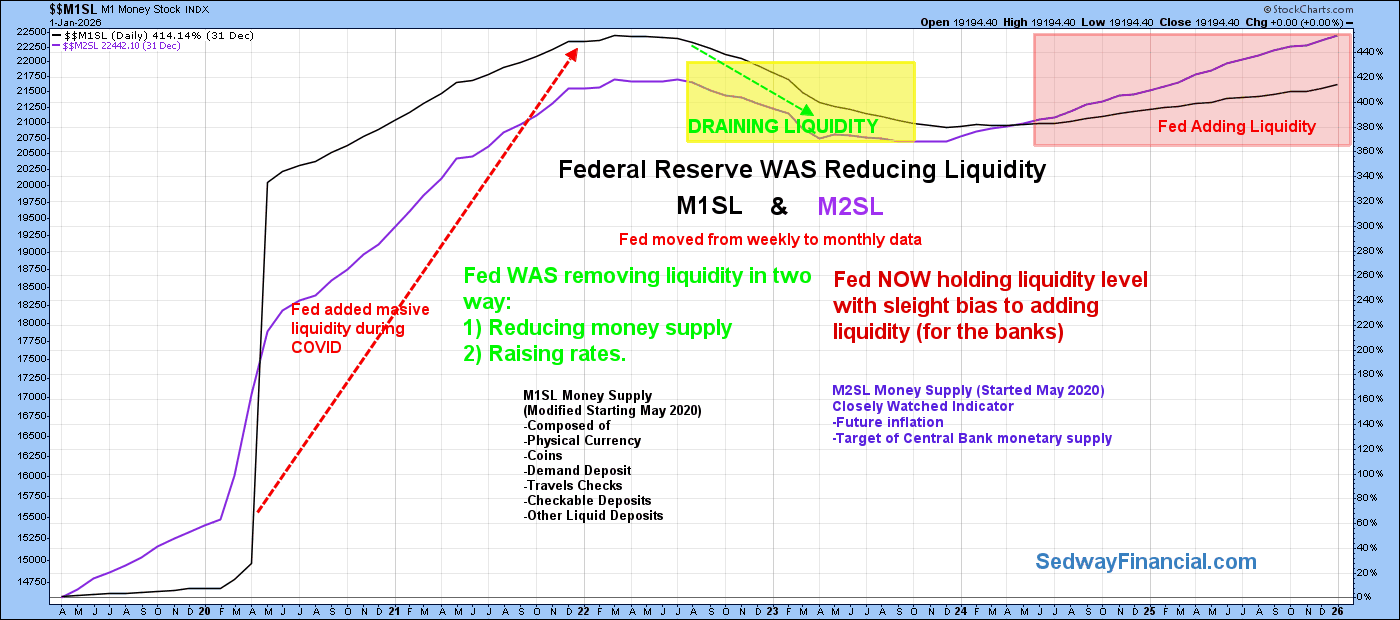
M1 includes highly liquid money such as:
- Physical currency
- Checking accounts
- Demand deposits
M2 is a broader measure that includes everything in M1 plus:
- Savings accounts
- Money market accounts
- Small time deposits
During the pandemic, aggressive fiscal and monetary stimulus caused money supply to surge rapidly. This increase in liquidity helped support economic activity but also contributed to inflation pressures that emerged in 2021 and 2022.
More recently, money supply growth has slowed as the Federal Reserve raised interest rates and tightened financial conditions. U.S. M2 money supply has stabilized near $22 trillion, reflecting a significant shift from the rapid expansion seen during the pandemic.
Economists also track the velocity of money, which measures how quickly money circulates through the economy. Together, money supply and velocity help determine how inflation pressures evolve.
4. A Cooling Labor Market
The labor market has been one of the strongest pillars of the post-pandemic recovery, but recent data suggests hiring momentum is beginning to slow.
Several indicators point to a gradual cooling:
- Job openings have declined from their peak
- Hiring activity has moderated
- Companies appear more cautious about expanding payrolls
While this does not necessarily signal a recession, a cooling labor market combined with persistent inflation can resemble a stagflation-lite environment.
Why Stagflation Creates a Challenge for the Federal Reserve
Stagflation-like conditions create a difficult policy environment for central banks.
Typically, the Federal Reserve lowers interest rates to stimulate growth during economic slowdowns. However, if inflation remains elevated, cutting rates too quickly could reignite inflation pressures.
This creates a policy dilemma:
- Lower rates too soon and inflation may rebound.
- Keep rates high for too long and economic growth may weaken further.
What This Means for Investors
For investors, a stagflation-lite environment can create mixed conditions across financial markets, including slower earnings growth, persistent interest-rate uncertainty, and increased market volatility.
However, short-term economic uncertainty does not necessarily derail long-term investment strategies:
- Diversification
- Maintaining a long-term perspective
- Regularly reviewing portfolios
- Maintaining liquidity
All remain important principles for navigating uncertain economic environments.
The Bottom Line
The global economy is navigating a complex mix of forces, including geopolitical tensions, energy market volatility, evolving trade policies, persistent inflation, changing money supply conditions, and a gradually cooling labor market.
While the U.S. economy is not currently experiencing the severe stagflation of the 1970s, these dynamics have led economists to increasingly discuss the possibility of stagflation lite.
Market conditions will naturally change over time, but a disciplined, long-term financial strategy remains one of the most effective ways to navigate changing market conditions. We continue to monitor developments closely and remain focused on helping clients stay aligned with their long-term financial goals.
If you would like to review your financial plan or discuss how current market conditions may impact your strategy, we welcome the opportunity to speak with you. You may Schedule an Appointment or call 916-833-6100.
We seek to provide you with the clarity, confidence, commitment, and choices to achieve your financial goals, giving you a newfound understanding of just how much is possible.
Data and rates used were indicative of market conditions as of the date shown. Opinions, estimates, forecasts, and statements of financial market trends are based on current market conditions and are subject to change without notice. References to specific securities, asset classes and financial markets are for illustrative purposes only and do not constitute a solicitation, offer, or recommendation to purchase or sell a security. Past performance is not a guarantee of future results.